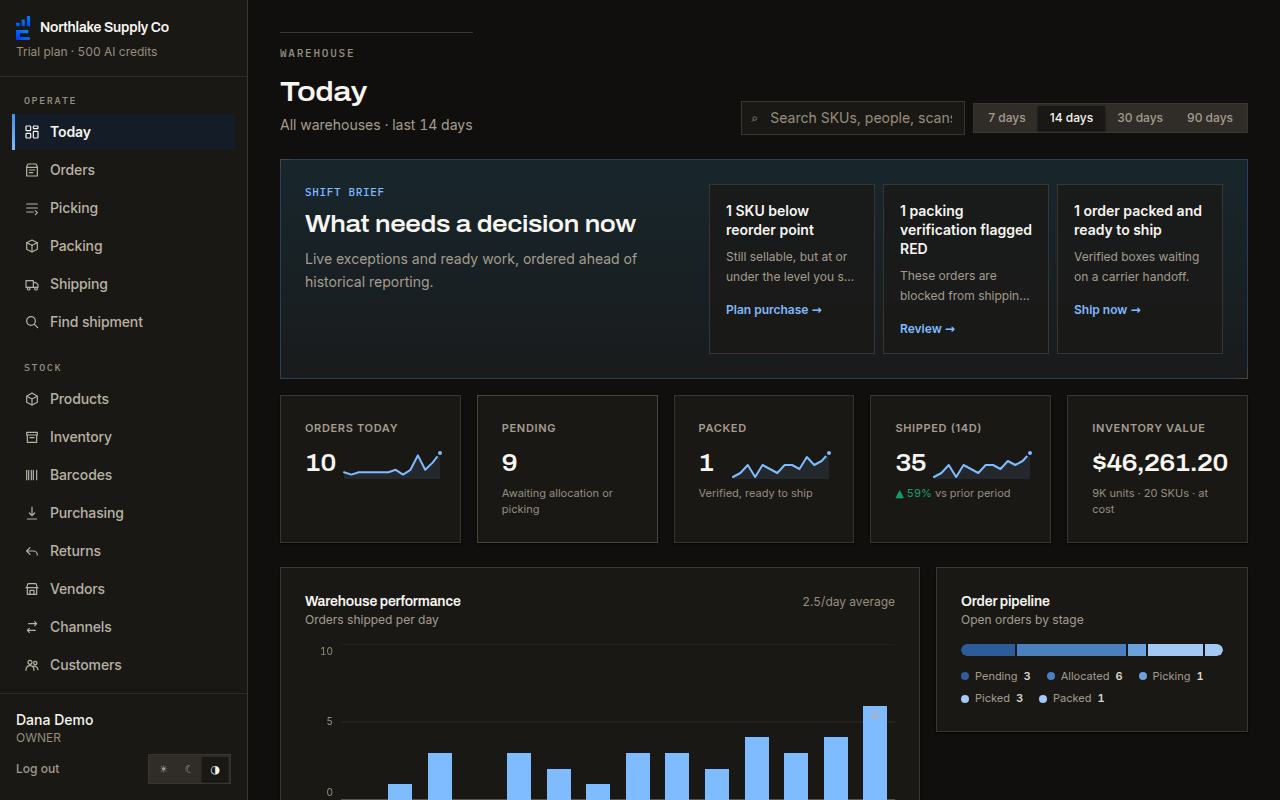
Know what left the dock · replace spreadsheet inventory for good

Warehouse management without the blind spots

Warehouse management software that keeps every unit, pick and box accountable — from receiving to carrier handoff, with practical AI on every plan.

14-day full-access trialNo card requiredFrom $100/month

Allocation

FEFO

Nearest expiry out first, not merely oldest received — across every warehouse and bin

Scanning

Code 128

Labels and scanning on a USB gun or the phone already in your pocket

Verification

Per unit

Counted at the shelf, or scanned into the box, or photographed and checked — your call

Built to earn trust

Your data stays portable

CSV exports, a documented REST API and webhooks are available without a special exit process.

Your hardware already works

Use phone cameras, ordinary tablets and USB barcode scanners without buying a proprietary fleet.

Every critical change is recorded

Inventory movements, scans, operator actions and account access remain traceable.

Operational outcomes

Less time reconciling. Fewer mistakes reaching customers.

01

Trust the number on screen

Stock stays tied to its warehouse, bin and lot. Reserved, quarantined and expiring units remain visible without being mistaken for sellable inventory.

Live availability · FEFO allocation · full movement history

02

Move orders without guesswork

Every handoff has a next action: allocate, walk the route, scan the pick, verify the box and record the carrier handoff.

Guided picking · phone scanning · batch and tote workflows

03

Catch the expensive mistake

Exceptions rise before they become customer problems, from short receipts and low stock to a product that does not belong in the box.

Receiving controls · reorder advice · pack verification

See the workflows in the product →

What it costs

Three plans. Every one is a whole warehouse.

The AI is on all of them — parsing, matching, the copilot and the reorder advisor start on the cheapest plan. What the tiers add is scale: batch picking and inbound tracking as your floor grows, vision verification and regional analytics when you are running several.

Compare the plans →

Starter

$100/mo

The whole warehouse, and the everyday AI

750 AI credits · 5 seats

Growth

$250/mo

Adds batch picking, inbound tracking and supplier claims

3,500 AI credits · 20 seats

Scale

$550/mo

Adds vision verification, regional analytics and priority support

15,000 AI credits · 100 seats

Start with your real stock, not a demo dataset.

Import your catalog, print barcodes, and run a pick the same afternoon. We’re onboarding warehouses in small batches right now — request access and your invite starts a 14-day trial with every capability switched on, no card required.

Common questions

What is Kinetel?

Kinetel is warehouse management software for growing product companies. It tracks stock by warehouse, bin and lot; generates and scans barcodes; reserves stock against orders and builds walk-sequenced pick routes; verifies what goes in the box before it ships; and handles purchase orders, receiving and returns. It also parses orders out of emails and spreadsheets, answers questions about your own stock, and advises what to reorder — on every plan rather than only the top one.

What hardware do I need?

Nothing you do not already have, in most warehouses. Picking, packing and receiving all run in a browser on a phone or tablet, and the phone camera reads barcodes. A USB barcode gun at around $25 to $40 makes a fixed packing bench faster and needs no drivers. Rugged handheld terminals work but are not required, which matters because a fleet of them is a five-figure decision and a lead time before you can start.

Does it handle lot numbers and expiry dates?

Yes, including FEFO allocation — first expired, first out — so an order is filled from the nearest-expiring lot rather than simply the oldest one received. The lot is recorded against the order line at the moment of the pick, which is what makes a recall answerable in both directions: every customer who received a given lot, and which lot any given customer received. Quarantined stock counts toward on-hand but is excluded from available, so it reconciles against a physical count without ever being allocated.

Which sales channels does it connect to?

Shopify, WooCommerce and Amazon, with paid orders imported automatically and carrier plus tracking pushed back so the storefront marks the order shipped and emails the customer. There is also a documented REST API and webhooks for anything else — an order can be posted in with your own reference on it, and the order.shipped webhook returns that same reference alongside the carrier and tracking number, so a custom storefront can fill in its own tracking field without storing our identifiers.

How long does setup take?

A single warehouse with a few hundred SKUs is typically running within a few days. The software setup is the fast part; what takes the time is producing a clean product list with real SKUs and correct barcodes, deciding what your bins are called, and doing one full physical count so the opening numbers are true. Going live on a count nobody trusts is the most common way a warehouse rollout goes wrong.

Can I get my data out?

Yes. Every list exports as CSV, and there is a documented REST API with API keys and webhooks covering orders, products, stock and shipments. This is worth asking every vendor before you sign rather than after, because it is the question that matters most on the day you leave — which is exactly when you have the least leverage to ask it.